
Medically reviewed by Michael Shnayder, DDS, MD
November 16, 2026
When a tooth is lost, the replacement decision usually gets framed as a price question. It is really three different questions: What does the option ask of the teeth around it? What does it ask of you every day? And how long before you are paying to redo it? Implants, bridges, and dentures each answer those questions differently, and none of them is the right answer for everyone. Here is the comparison we walk through with our own patients in Omaha.
The three options, in plain terms
A dental implant is a small post placed in the jawbone where the tooth root used to be — usually titanium, and in the right case zirconia, a strong tooth-colored ceramic. Once it has healed and fused with the bone, it carries a crown that looks and works like a single tooth. It stands on its own — the teeth next to it are not touched.
A bridge is a false tooth held in place by crowns on the teeth on either side of the gap. Those neighboring teeth are reshaped so the crowns can fit over them, and the three pieces are made as one connected unit.
A denture is a removable appliance. A partial denture replaces several missing teeth and clips around the ones that remain; a full denture replaces an entire arch and rests on the gums. Both come out at night.
What each one asks of the neighboring teeth
This is the difference patients most often have not heard. A bridge borrows strength from its neighbors, and borrowing has a cost: two teeth that may be perfectly healthy are cut down for crowns, and from then on, if one of those teeth fails, the whole bridge is usually involved. An implant asks nothing of its neighbors — which is also why it is often the better choice when the adjacent teeth have never had a filling.
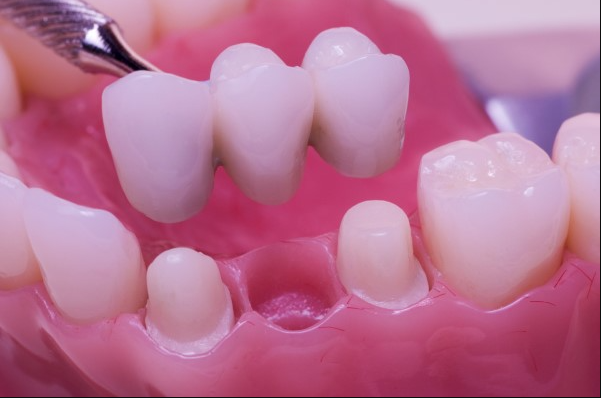
A bridge held over the two teeth that were ground down to receive it, with the empty socket of the missing tooth between them. The tooth structure removed to make room for a bridge does not grow back — the preparation is permanent.
An implant asks something else instead: bone. The post needs enough healthy jawbone to hold it, and a tooth that has been missing for a while often means the bone in that spot has thinned. That is not a dead end — bone grafting rebuilds the site — but it adds a step, and it is one reason a consultation includes a 3D scan rather than a guess.
A denture asks the least of any single tooth and the most of the mouth as a whole. The remaining teeth carry extra load, and the gum ridge under a denture slowly changes shape over the years, which is why dentures loosen and need relining or remaking.
Titanium or zirconia implants?
Most implants are titanium, and titanium carries the longest track record — decades of results behind it. Zirconia implants are the newer option: a ceramic post with no metal in it at all. Patients ask about zirconia for two reasons. Some simply prefer to avoid metal. Others are replacing a front tooth, where a gray titanium post can occasionally show a faint shadow through thin gums — zirconia is tooth-colored, so there is nothing gray to show through.
The honest trade-offs: zirconia’s long-term record is shorter than titanium’s, its one-piece design leaves less flexibility in positioning the crown, and it is not the right choice for every bite. For most back teeth, titanium remains the default. For the right front-tooth case — or a patient who feels strongly about metal-free — zirconia is a genuine option, and it is worth raising at the consultation rather than assuming titanium is the only material on the table.
How they feel day to day
Patients describe the difference simply: an implant is the only option most people forget about. It is cleaned like a natural tooth, it does not move, and chewing force goes back into the bone — which is also what keeps that bone from shrinking away over time.
A bridge feels fixed and solid, but cleaning under it takes an extra step (threaders or a water flosser to reach beneath the false tooth), and that step is not optional — the area under a bridge is exactly where decay and gum problems like to start.
A denture is the biggest adjustment. Lower dentures especially tend to move when you eat or speak, adhesives help some people and annoy others, and most patients are aware of the appliance in a way implant and bridge patients are not. For someone missing most or all of an arch, there is a middle path worth knowing about: All-on-X anchors a full arch of teeth to a small number of implants, so the teeth are fixed in place and do not come out — it replaces the denture experience, not just the denture.
How long each one lasts
Honest numbers, with the caveat that every mouth is different:
- Implants have the longest track record of the three. The implant itself can last decades — often the rest of a patient’s life — while the crown on top may eventually need replacement from wear, much like a crown on a natural tooth.
- Bridges typically serve around ten to fifteen years before the unit needs replacement, most often because of decay or failure in one of the supporting teeth.
- Dentures generally need relining every few years and remaking in the range of five to eight years as the ridge changes shape.
That lifespan math is why the cheapest option today is not always the cheapest option over twenty years — and why we would rather show you the comparison than steer you.
The honest downsides of each
Implants take the longest: placement, a healing period while the post fuses with the bone, then the crown. They are a surgical procedure, with the planning and recovery that involves. And they cost the most up front for a single tooth.
Bridges are faster — usually a few weeks — and involve no surgery. The trade is the reshaped neighbor teeth and the shorter lifespan.
Dentures are the fastest and least expensive way to replace many teeth at once, and they involve no surgery. The trades are movement, daily removal, reduced chewing strength, and a fit that changes as your mouth does.
So how do you choose?
A few patterns from our own consultations:
- One tooth missing, healthy neighbors: an implant usually wins, because nothing else has to be sacrificed to place it.
- A front tooth, thin gums, or a preference for metal-free: ask whether a zirconia implant fits your case.
- One tooth missing, neighbors already heavily restored: a bridge deserves a fair look — those teeth may need crowns anyway.
- Several teeth missing in a row: implants, a longer bridge, or a partial denture can all work; bone, budget, and how the bite loads the area decide it.
- Most or all of an arch gone: compare a denture against an implant-anchored fixed arch before deciding — they are different lives, not just different prices.
Cost matters, and we will give you exact numbers for your case at a consultation rather than ranges on a website. The practice also works with patient financing, so a longer-lasting option does not have to be paid for all at once.
If you are weighing a replacement — or wearing a denture you are tired of thinking about — call Village Pointe Oral Surgery in Omaha at 402-317-5657 to schedule an evaluation. Bring your questions; this comparison is the starting point of the conversation, not a substitute for it.